What is a Saturn return?
The slow audit that arrives near thirty, and again near sixty.
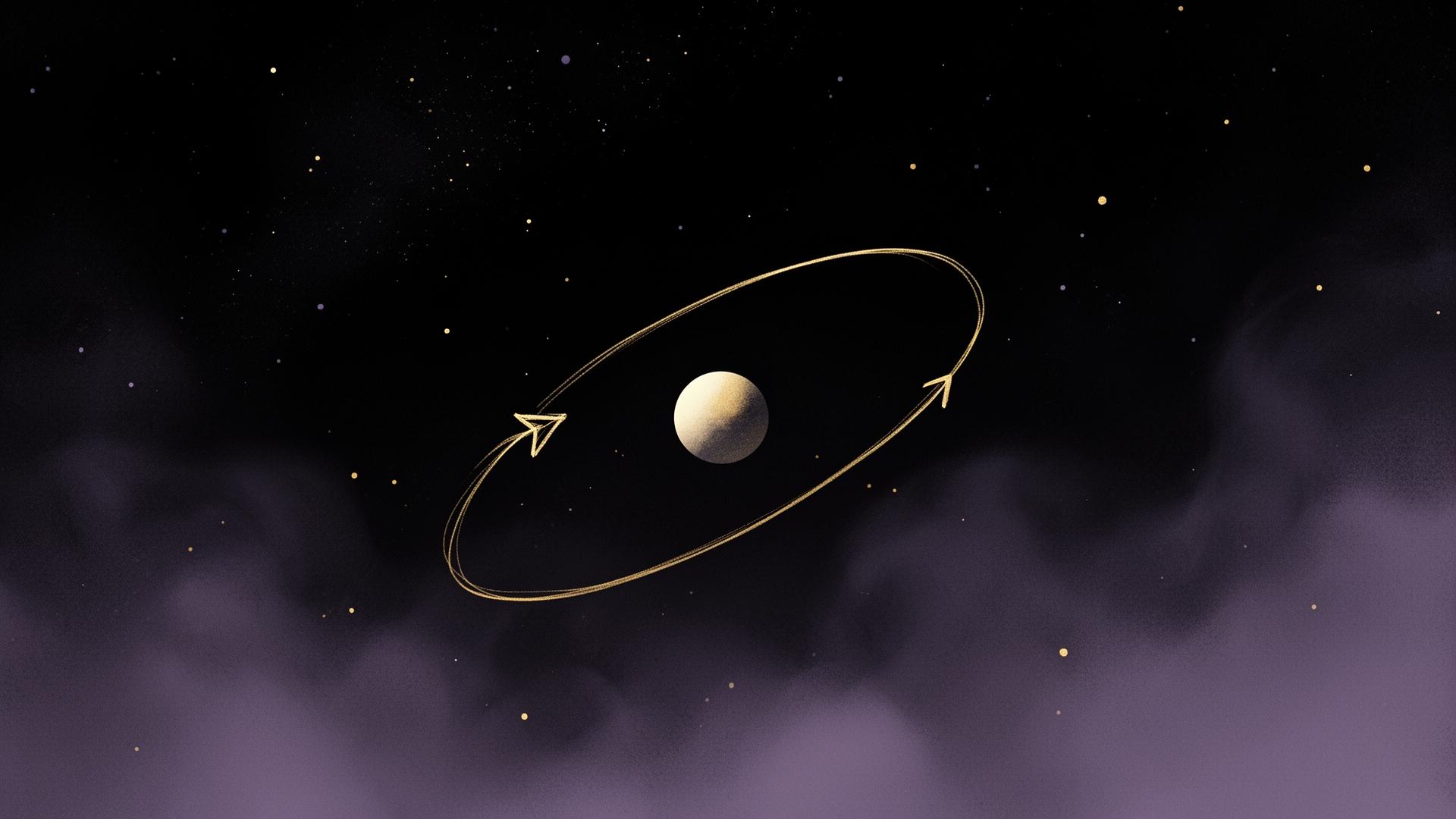
A Saturn return is the period when Saturn comes back to the place it occupied in the sky on the day you were born. Saturn takes about twenty-nine and a half years to travel once around the zodiac, so your first Saturn return falls somewhere between the ages of 27 and 30, the second between about 57 and 60, and, for those who live long enough, a third in the late eighties. It is one of the few transits that almost everyone has heard of, and one of the few that almost everyone, looking back, recognises.
People tend to describe their Saturn return as a reckoning. That is not wrong, but it is incomplete. It is less a storm than an audit: a slow, thorough look at the life you have built so far, and an invitation to keep what holds weight.
Why Saturn, and why then
Saturn is the furthest planet you can see with the naked eye, and for most of history it marked the edge of the known sky. Astrologers gave it the themes that live at edges: time, limits, structure, responsibility, consequence, mastery. Saturn is the planet of things that take a long time to build and cannot be faked.
Because it moves so slowly, Saturn does not touch its birth position for a single afternoon. It approaches, retrogrades, and crosses the same degree as many as three times, so a Saturn return usually unfolds over two or three years. There is often a build-up, a hard middle, and a slow settling.
The timing also matches something real about a human life. By the late twenties, the choices you made at twenty-two have had long enough to show their consequences. The jobs, relationships, cities and habits you drifted into are no longer temporary. They are starting to become your life, and some part of you notices. The Saturn return is the name astrology gives to that noticing.
What it asks
A Saturn return asks a simple question with an uncomfortable edge: what in your life is actually yours?
By your late twenties you are carrying a lot of borrowed material. Your parents' expectations. Your friends' timelines. A career chosen because it sounded sensible. A relationship that began when you were someone else. The return tends to test each of these, gently or otherwise. What was chosen out of fear or habit often loosens or falls away. What was chosen honestly tends to get stronger, sometimes in ways that require more commitment than you expected.
This is why Saturn returns are associated with so many endings and so many beginnings. People leave jobs, end relationships, move cities, go back to school. People also marry, have children, start businesses, sign leases, finally commit to the thing they had been circling for years. From the outside these look like opposite stories. From the inside they are the same one: the end of drifting.
Saturn is not punitive, but it is exact. It rewards effort, honesty and patience, and it is unmoved by shortcuts. If you have been building on solid ground, the return can feel like a promotion you earned. If you have been avoiding something, it tends to arrive at your door with the paperwork.
Where it lands in your chart
Everyone has a Saturn return, but not everyone has the same one. The sign and house Saturn occupies in your birth chart describe where the review is likely to concentrate.
Saturn in the tenth house often makes the return a story about career and public life. In the seventh, it is about partnership and commitment. In the fourth, home, family and roots. In the second, money and self-worth. The sign colours the lesson. Saturn in Libra asks about fairness in relationships. Saturn in Capricorn, its own sign, asks about authority and ambition. Saturn in Pisces asks how to give a structure to something that has always been formless, such as faith, art or compassion.
If you know your birth time, look at the house as well as the sign. It is often the most precise description of where your own audit is happening.
The second return
The second Saturn return, between about 57 and 60, gets less attention, but people who have lived through it often describe it as the more freeing of the two.
At thirty, Saturn asks you to build. At sixty, it asks what you have built, what you want to keep, and what you are finally ready to put down. The questions turn toward legacy, health, time and the quiet release of having to prove anything. Many people describe a narrowing that feels less like loss and more like focus: fewer obligations, chosen more carefully, held with more ease.
The Saturn-in-Aries cohort, now
Saturn entered Aries for good in February 2026 and stays there until 2028. That means everyone born with Saturn in Aries is somewhere in their return right now.
For the first return, that is mostly people born between spring 1996 and early 1999, who are turning roughly 27 to 30 during these years. One detail: for part of mid-to-late 1998, Saturn briefly moved into Taurus before returning to Aries, so if you were born in the second half of that year it is worth checking your chart. Your return may be the Taurus one, which begins in 2028.
Saturn in Aries is a placement about the self. Aries is the sign of initiative, independence, courage and anger. With Saturn there, the lifelong lesson is learning to act under your own authority, neither waiting for permission nor charging ahead without a plan. At the return, that lesson becomes concrete. Many people in this cohort are being asked to stop building someone else's idea of a life and to start, deliberately and perhaps for the first time, something with their own name on it. Others are learning the opposite skill: patience, discipline, the difference between being brave and being impulsive.
There is an added layer this time. Neptune is also in early Aries, and Saturn met it there in February 2026. For this cohort, the rebuilding of the self is not only practical. It is also a question of belief. What do you actually have faith in, now that the beliefs you were handed have been tested? The answer does not need to be large. It needs to be honest enough to build on.
People born roughly between 1967 and 1969 also have Saturn in Aries, and they are in their second return at the same time. It is not unusual for a parent and child, or a mentor and student, to be doing the same homework thirty years apart. If that describes you, the conversation can be a good one.
A few things it is not
It is not a curse. Plenty of people meet their Saturn return with relief, because it finally gives them permission to stop doing something that was never theirs.
It is not a single birthday. The return can begin a year or more before the exact crossing and continue for months after it, which is why so many people say they only understood it in hindsight.
It is not the same for everyone. Some returns are loud, with a move, a breakup and a new job in the same season. Others are almost invisible from the outside: a private decision, a change of attitude, a quiet new seriousness about something you used to treat as a hobby. Both count.
And it is not the end of anything you truly want. Saturn removes what is borrowed. It rarely takes what is real.
How to meet it
There is no way to skip a Saturn return, and no need to fear one. A few things help.
Slow your decisions down. Saturn favours what is considered over what is urgent. Let some things end without forcing them to end faster. Choose one or two real commitments rather than many half-ones. Ask for structure, from a mentor, a routine, a therapist, a calendar. And be honest with yourself about what you are carrying because you want it, and what you are carrying because you have not yet put it down.
Then remember that the return ends. When it does, most people find a quieter, steadier kind of confidence on the other side, the kind that comes from having been tested and found to hold. Astra shows where Saturn sits in your chart and when it returns, so you can read this season as a chapter rather than a crisis.